

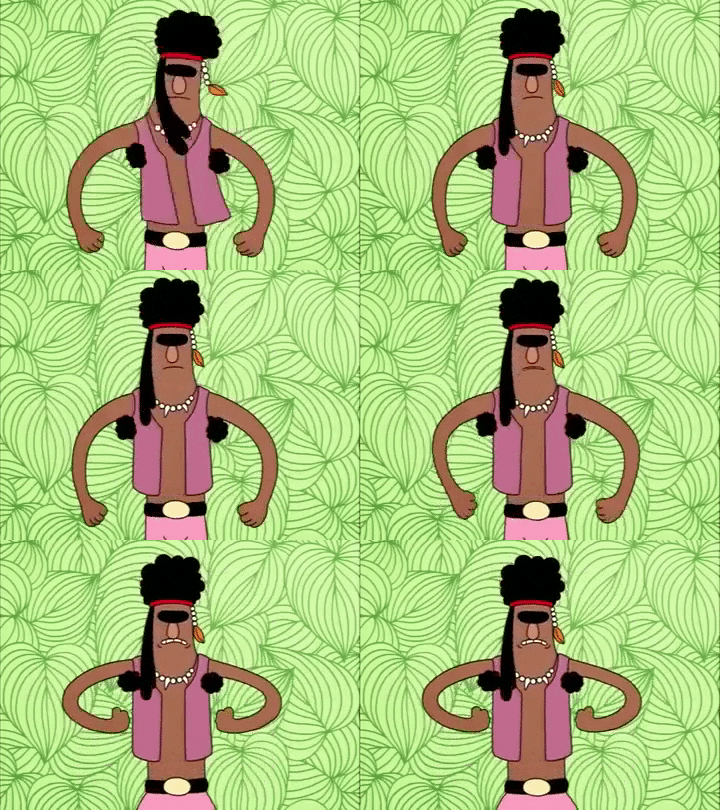
What the hell is machismo? But I’m pretty sure you heard the adjective “macho”; an adjective used to describe men. Machismo can be defined as an attitude of exaggerated masculinity: a strong sense of male pride. This term ‘macho’ has a long history in Spanish countries and Portugal. But certainly it can be seen in the Caribbean. Throughout popular literature and even in humanitarian reports, this term is associated with negative characteristics such as sexism, misogyny, hypermasculinity. Many scholars characterise macho men as violent, rude, womanizing and prone to alcoholism.
Machismo is deemed as a cultural factor in many societies. One key aspect to note is machismo’s influence on a man’s behaviour, one where he has to prove his strength in society. Males are expected to be tough and not show much emotions. Of course there exists great pressure “to be a man” in many societies in the world. Experts have found and outlined behavioual patterns around the machismo culture.
1. Restrictive emotionality– restraining oneself from expressing emotions. We see this almost everyday, where men are called names for expressing their feelings like crying in public or being overly sensitive.
2. Homophobia– the fear of homoesexuals and even discrimination against homosexuals. Interestingly, I have noticed that some males approve of lesbianism but disapprove of gays in society.
3. Socialized control, power, competition – the desire to be in charge, commanding others and to excel above others. Whatever these men command, it must be done. This can be seen in almost every societal institution especially within households and the labour markets where men want to be on top of the social and economical ladder at all times.
4. Male infidelity– there exists pressure for a man to be sexually experienced. Male infidelity are practiced in many cultures as men are not expected to hold the same level of chastity as women. In Latin america and other regions, girls are taught to tolerate unfaithful partners, since it is part of the machismo culture.
Without a doubt, you can see that this machimso culture isn’t just found in Latin america but also in the Caribbean. All those behaviours listed above can be noted in a large number of men in our society. Education is said to be the solution to the problem. But this attitude is spread through the socialization process starting from infancy. For instance, a child seeing his father abuse his mother and she does not fight back or leave, there is a high possibility that this boy will grow up and emulate his father’s actions and the cycle continues. Or a boy is taught not to cry or express his feelings openly, he may very well pass that attitude on to his son in the future. There is a lot of work to be done in schools and at home to change such negative attitudes.
111
 Home | Reshma Catherine